Khóa học
IELTS Online
IELTS Online
Giảm đến 18%
Đăng ký ngay
Mục lục [Ẩn]
Bài viết này sẽ giúp bạn giải trọn vẹn đề thi thật IELTS Reading “The Pearl ” với đầy đủ đề bài, câu hỏi, đáp án chi tiết kèm giải thích rõ ràng. Đây sẽ là tài liệu hữu ích để bạn ôn luyện và nâng cao kỹ năng Reading, sẵn sàng chinh phục band điểm mục tiêu trong kỳ thi IELTS.
The Pearl
A. The pearl has always had a special status in the rich and powerful all through the history. For instance, women from ancient Rome went to bed with pearls on them, so that they could remind themselves how wealthy they were after waking up. Pearls used to have more commercial value than diamonds until jewelers learnt to cut gems. In the eastern countries like Persia, ground pearl powders could be used as a medicine to cure anything including heart diseases and epilepsy.
B. Pearls can generally be divided into three categories: natural, cultured and imitation. When an irritant (such as a grain of sand) gets. inside a certain type of oyster, mussel, or clam, the mollusc will secrete a fluid as a means of defense to coat the irritant. Gradually, layers are accumulated around the irritant until a lustrous natural pearl is formed.
C. A cultured pearl undergoes the same process. There is only one difference between cultured pearls and natural ones: in cultured pearls, the irritant is a head called ‘mother of pearl’ and is placed in the oyster through surgical implantation. This results in much larger cores in cultivated pearls than those in natural pearls. As long as there are enough layers of nacre (the secreted fluid covering the irritant) to create a gorgeous, gem-quality pearl; the size of the nucleus wouldn’t make a difference to beauty or durability.
D. Pearls can come from both salt and freshwater sources. Typically, pearls from salt water usually have high quality, although several freshwater pearls are considered high in quality, too. In addition, freshwater pearls often have irregular shapes, with a puffed rice appearance. Nevertheless, it is the individual merits that determine the pearl’s value more than the sources of pearls. Saltwater pearl oysters are usually cultivated in protected lagoons or volcanic atolls, while most freshwater cultured pearls sold today come from China. There are a number of options for producing cultured pearls: use freshwater or seawater shells, transplant the graft into the mantle or into the gonad, add a spherical bead or do it non-beaded.
E. No matter which method is used to get pearls, the process usually takes several years. Mussels must reach a mature age, which may take up to almost three years, and then be transplanted as an irritant. When the irritant is put in place, it takes approximately another three years for a pearl to reach its full size. Sometimes, the irritant may be rejected. As a result, the pearl may be seriously deformed, or the oyster may directly die from such numerous complications as diseases. At the end of a 5- to 10-year circle, only half of the oysters may have made it through. Among the pearls that are actually produced in the end, only about 5% of them will be high-quality enough for the jewelry makers.
F. Imitation pearls are of another different story. The Island of Mallorca in Spain is renowned for its imitation pearl industry. In most cases, a bead is dipped into a solution made from fish scales. But this coating is quite thin and often wears off. One way to distinguish the imitation pearls is to have a bite on it. Fake pearls glide through your teeth, while the layers of nacre on the real pearls feel gritty.
G. Several factors are taken into account to evaluate a pearl: size, shape, Colour, the quality of surface and luster. Generally, the three types of pearls come in such order (with the value decreasing): natural pearls, cultured pearls and imitation pearls (which basically are worthless). For jewelers, one way to tell whether a pearl is natural or cultured is to send it to a gem lab and perform an X-ray on it. High-quality natural pearls are extremely rare. Japan’s Akoya pearls are one of the glossiest pearls out there, while the’ south sea water’ of Australia is a cradle to bigger pearls.
H. Historically, the pearls with the highest quality around the globe are found in the Persian Gulf, particularly around Bahrain. These pearls have to be hand-harvested by divers with no advanced equipment. Unfortunately, when the large reserve of oil was discovered in the early 1930s, Persian Gulf’s natural pearl industry came to a sudden end because the contaminated water destroyed the once pristine pearls. In the present days, India probably has the largest stock of natural pearls. However, it is quite an irony that a large part of India’s stock of natural pearls are originally from Bahrain.
Questions 1-4
Reading Passage 1 has eight paragraphs, A-H.
Which paragraph contains the following information?
Write the correct letter, A-H, in boxes 1-4 on your answer sheet.
1. ancient stories around pearls and its customers
2. difficulties in cultivating process
3. factors which decide the value of natural pearls
4. a growth mechanism that distinguishes cultured pearls from natural ones
Questions 5-10
Complete the summary below.
Choose NO MORE THAN TWO WORDS from the passage for each answer.
Write your answers in boxes 5-10 on your answer sheet.
In history, pearls have had great importance within the men of wealth and power, which were treated as gems for women in 5…… Also, pearls were even used as a medicine for people in 6…….There are essentially three types of pearls: natural, cultured and imitation. Most freshwater cultured pearls sold today come from China while 7……Island is famous for its imitation pearl industry. Good-quality natural pearls are exceedingly unusual. 8……often manufactures some of the glitteriest pearls while 9…..produces larger size ones due to the favorable environment along the coastline. In the past, 10……in the Persian Gulf produced the world’s best pearls. Nowadays, the major remaining suppliers of natural pearls belong to India.
Questions 11-13
Do the following statements agree with the information given in Reading Passage 1?
In boxes 11-13 on your answer sheet, write
TRUE if the statement agrees with the information
FALSE if the statement contradicts the information
NOT GIVEN If there is no information on this
11. Generally speaking, the center of a cultured pearl is significantly larger than that of a natural pearl.
12. Sometimes, fake pearls can be more expensive.
13. The size of the pearls produced in Japan is usually smaller than those in Australia.
=> Xem thêm: Top Website luyện IELTS Reading miễn phí tốt nhất
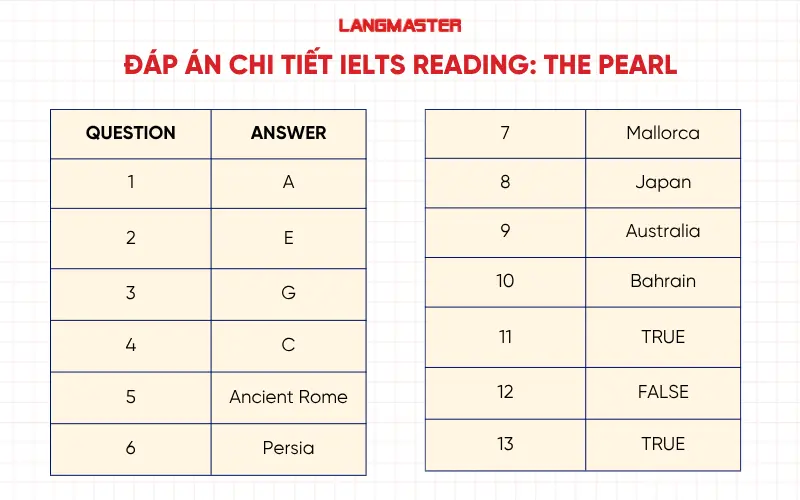
Questions 1-4
1. ancient stories around pearls and its customers
Thông tin đoạn A: “The pearl has always had a special status in the rich and powerful all through the history. For instance, women from ancient Rome went to bed with pearls on them… In the eastern countries like Persia, ground pearl powders could be used as a medicine...”
Đoạn A nói về những câu chuyện trong lịch sử liên quan đến ngọc trai — như phụ nữ La Mã cổ đại đeo ngọc khi ngủ và người Ba Tư dùng ngọc trai làm thuốc. Đây đều là ví dụ về người dùng ngọc trai và các câu chuyện xung quanh nó.
=> Đáp án: A
2. difficulties in cultivating process
Thông tin đoạn E: “No matter which method is used to get pearls, the process usually takes several years... Sometimes, the irritant may be rejected... or the oyster may directly die... only about 5% of them will be high-quality enough for the jewelry makers.”
Đoạn E mô tả quá trình nuôi cấy kéo dài nhiều năm, với tỷ lệ chết cao và chỉ 5% ngọc trai đạt chất lượng tốt. Tất cả thể hiện những khó khăn và rủi ro trong quá trình nuôi cấy.
=> Đáp án: E
3. factors which decide the value of natural pearls
Thông tin đoạn G: “Several factors are taken into account to evaluate a pearl: size, shape, colour, the quality of surface and lustre... Generally, the three types of pearls come in such order (with the value decreasing)...”
Đoạn G liệt kê rõ các yếu tố quyết định giá trị của ngọc trai — gồm kích thước, hình dạng, màu sắc, bề mặt và độ bóng — đồng thời nêu thứ tự giá trị giữa các loại ngọc trai.
=> Đáp án: G
4. a growth mechanism that distinguishes cultured pearls from natural ones
Thông tin đoạn C: “A cultured pearl undergoes the same process… The only difference between cultured pearls and natural ones is… the irritant is a bead called ‘mother of pearl’ and is placed in the oyster through surgical implantation.”
Đoạn C chỉ ra cơ chế hình thành khác biệt giữa ngọc tự nhiên và ngọc nuôi: ngọc nuôi được con người cấy nhân “mother of pearl” vào con hàu. Đây là điểm khác biệt trong quá trình phát triển.
=> Đáp án: C
Questions 5-10
5. Từ loại cần điền: Danh từ riêng
Thông tin đoạn A: “For instance, women from ancient Rome went to bed with pearls on them, so that they could remind themselves how wealthy they were after waking up.”
=> Đáp án: ancient Rome
6. Từ loại cần điền: Danh từ riêng
Thông tin đoạn A: “In the eastern countries like Persia, ground pearl powders could be used as a medicine to cure anything including heart diseases and epilepsy.”
=> Đáp án: Persia
7. Từ loại cần điền: Danh từ riêng
Thông tin đoạn F: “The Island of Mallorca in Spain is renowned for its imitation pearl industry.”
=> Đáp án: Mallorca
8. Từ loại cần điền: Danh từ riêng
Thông tin đoạn G: “Japan’s Akoya pearls are one of the glossiest pearls out there...”
=> Đáp án: Japan
9. Từ loại cần điền: Danh từ riêng
Thông tin đoạn G: “... while the ‘south sea water’ of Australia is a cradle to bigger pearls.”
=> Đáp án: Australia
10. Từ loại cần điền: Danh từ riêng
Thông tin đoạn H: “Historically, the pearls with the highest quality around the globe are found in the Persian Gulf, particularly around Bahrain.”
=> Đáp án: Đáp án: Bahrain
Questions 11-13
11. Generally speaking, the center of a cultured pearl is significantly larger than that of a natural pearl.
Thông tin đoạn C: “This results in much larger cores in cultivated pearls than those in natural pearls.”
Giải thích: Đoạn C khẳng định ngọc trai nuôi có lõi (core) lớn hơn nhiều so với ngọc trai tự nhiên, đúng hoàn toàn với nội dung câu hỏi.
=> Đáp án: TRUE
12. Sometimes, fake pearls can be more expensive.
Đoạn F: “...a bead is dipped into a solution made from fish scales... this coating is quite thin and often wears off.”
Đoạn G: “Generally, the three types of pearls come in such order (with the value decreasing): natural pearls, cultured pearls and imitation pearls (which basically are worthless).”
Giải thích: Ngọc trai giả (imitation pearls) được mô tả là rất rẻ, gần như không có giá trị — vì vậy không thể đắt hơn.
=> Đáp án: FALSE
13. The size of the pearls produced in Japan is usually smaller than those in Australia.
Thông tin đoạn G: “Japan’s Akoya pearls are one of the glossiest pearls out there, while the ‘south sea water’ of Australia is a cradle to bigger pearls.”
Giải thích: Câu gốc nói rõ ngọc trai của Úc có kích thước lớn hơn, còn ngọc trai Nhật thì nổi tiếng vì độ bóng. Vì vậy, câu nói ngọc trai Nhật nhỏ hơn ngọc Úc là đúng theo ý bài.
=> Đáp án: TRUE
=> Xem thêm:
Để hiểu rõ hơn nội dung và các ý chính trong bài đọc The Story of Pearls, người học nên nắm vững những từ vựng quan trọng xuất hiện xuyên suốt bài. Dưới đây là danh sách các từ vựng IELTS Reading tiêu biểu, được ghi chú từ loại kèm nghĩa tiếng Việt ngắn gọn, giúp bạn dễ dàng ghi nhớ và áp dụng trong các bài đọc hoặc bài viết IELTS liên quan đến chủ đề jewelry (trang sức) và natural materials (vật liệu tự nhiên).
Khi luyện tập với các đề thi mẫu như đề IELTS Reading “The Pearl ”, chắc hẳn bạn sẽ có nhiều câu hỏi cần giải đáp về logic làm bài cũng như cách học từ vựng hiệu quả hơn. Để làm được điều đó, bạn có thể tìm một lộ trình học bài bản và một giáo viên giàu kinh nghiệm để giúp bạn tiến bộ nhanh trong việc luyện thi IELTS. Đây cũng là lúc bạn nên cân nhắc đến các khóa học IELTS online uy tín để vừa tiết kiệm thời gian của bản thân, vừa đạt hiệu quả tối đa.
Với hơn 16 năm kinh nghiệm giảng dạy tiếng Anh, Langmaster mang đến các khóa học IELTS online được thiết kế phù hợp với từng mục tiêu và năng lực đầu vào của học viên. Chính những ưu điểm nổi bật dưới đây đã giúp khóa học của Langmaster trở thành lựa chọn đáng tin cậy cho những ai muốn chinh phục IELTS một cách bền vững:
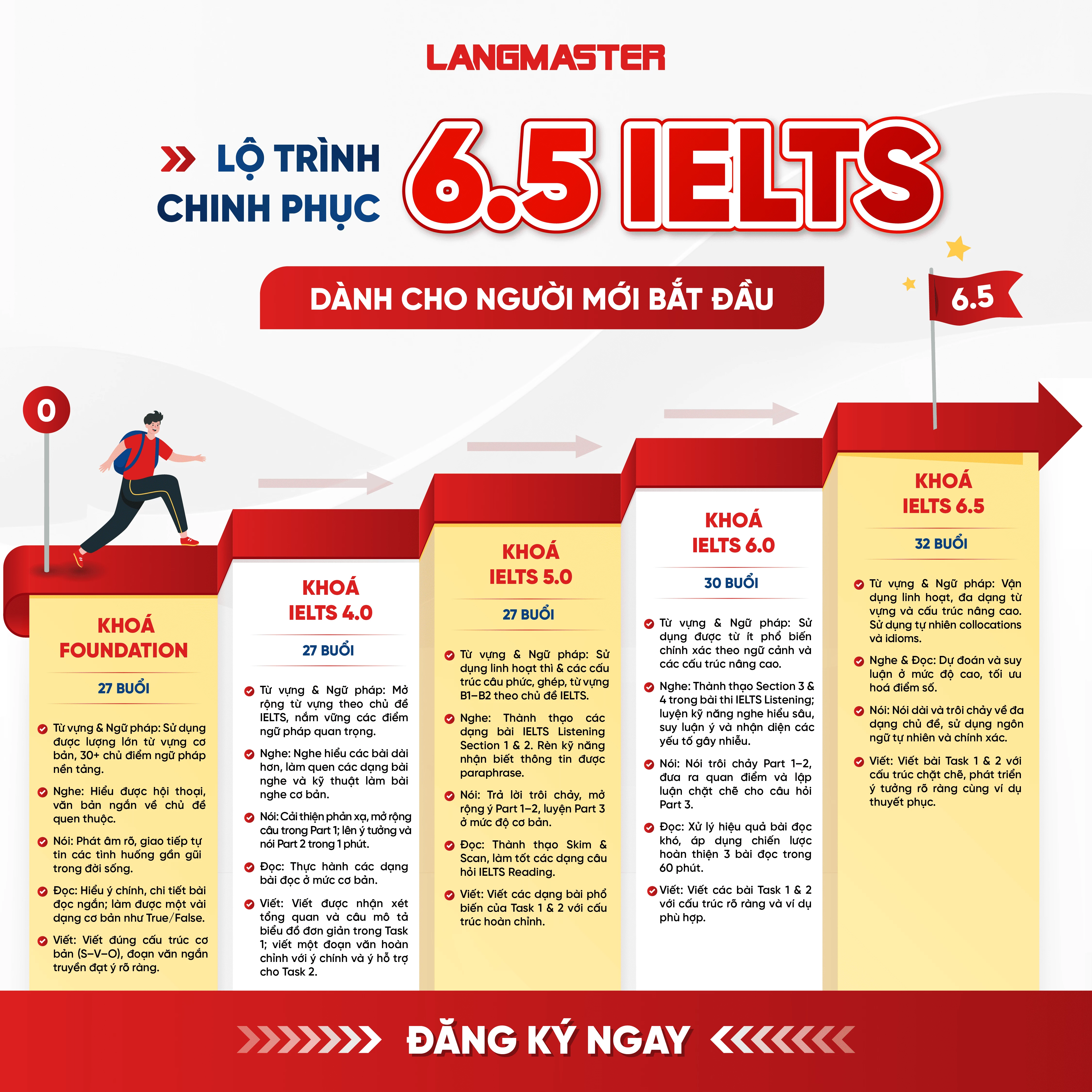
Đặc biệt, bạn còn có thể tham gia lớp học thử miễn phí tại Langmaster, trực tiếp trải nghiệm phương pháp giảng dạy và đánh giá mức độ phù hợp của khóa học trước khi quyết định đăng ký chính thức với trung tâm.
Trên đây là toàn bộ đáp án đề thi IELTS Reading “The Pearl” kèm giải thích chi tiết và từ vựng quan trọng. Khi luyện tập theo đề thi thật, bạn không chỉ nắm chắc cách làm dạng bài mà còn mở rộng vốn từ học thuật hữu ích cho kỳ thi. Hy vọng tài liệu này sẽ giúp bạn tự tin hơn, cải thiện kỹ năng đọc hiểu và tiến gần hơn tới band điểm IELTS mục tiêu.


Các dạng bài phổ biến và tiêu chí chấm điểm IELTS Reading chi tiết nhất: Multiple Choice, Matching Information, Matching Headings,... và hướng dẫn chiến lược làm bài hiệu quả
Những sai lầm khi luyện IELTS Reading bao gồm: dịch từng từ, đọc hết cả bài, không đọc câu hỏi trước, không quản lý thời gian, không nắm vững kỹ năng paraphrase, viết sai chính tả
![Giải đề IELTS Reading: A brief history of humans and food [full answers]](https://langmaster.edu.vn/storage/images/2025/09/20/a-brief-history-of-humans-and-food-ielts-reading-answers.webp)
Giải đề thi IELTS Reading “A brief history of humans and food” kèm full đề thi thật, câu hỏi, đáp án, giải thích chi tiết, và từ vựng cần lưu ý khi làm bài.
Tổng hợp IELTS Reading tips hay nhất giúp bạn đọc nhanh, nắm ý chính và xử lý thông tin chính xác, tự tin đạt điểm cao trong kỳ thi IELTS.
![Giải đề IELTS Reading: The importance of law [Full answers]](https://langmaster.edu.vn/storage/images/2025/09/22/55.webp)
Giải đề IELTS Reading “The importance of law” kèm đáp án chi tiết, từ vựng quan trọng và bí quyết luyện thi hiệu quả để nâng cao band điểm.




Hơn 16 năm kinh nghiệm, đào tạo thành công 800.000+ học viên
Phương pháp giảng dạy hiện đại, học viên tiến bộ rõ rệt
Lộ trình học chuẩn quốc tế, phù hợp với nhu cầu thực tiễn
Giáo viên đạt chuẩn Quốc tế với chất lượng top đầu thị trường, giàu kinh nghiệm
Học online linh hoạt, cam kết đầu ra bằng văn bản

![[TỔNG HỢP] TỪ VỰNG IELTS READING THEO CHỦ ĐỀ THƯỜNG GẶP](https://langmaster.edu.vn/storage/images/2025/10/01/tong-hop-tu-vung-ielts-reading-theo-chu-de-thuong-gap.webp)
![Giải đề IELTS Reading: Video Games and Violence [Full answers]](https://langmaster.edu.vn/storage/images/2025/10/02/giai-de-ielts-reading-video-games-and-violence-full-answers.webp)
.png)